Is your cat fat or skinny?

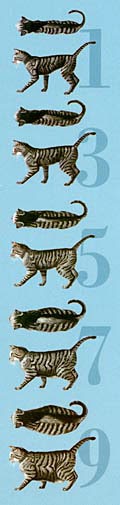
Keeping fat to a minimum is crucial to expanding your cat's life span, so it is important to visually and physically examine your cat. A cat's normal, healthy weight will vary depending on the breed, gender, and spay or neuter status. So here are some guidelines to determine if your cat's weight is normal.
  • Feel the cat's ribs. Ideally, there should be easily felt but not visibly sticking out. The ribs should be covered with a layer of fat, but not to an extent that would make it difficult to feel them. If you can see the ribs, the cat is too thin. If you can not feel them at all, the cat is very overweight.
  • Feel other bony prominences on the pet's body such as the the base of the tail, spine, shoulders, and hips. Anything more than light fleshiness indicates that your pet is above normal weight.
  • Look at the cat from above. The shoulders should be more broad and noticeable than the waist. The hindquarters should be broader than the waist. If the waist is significantly larger or very well rounded in comparison with the shoulders and hindquarters, the cat is overweight.
  • Look at the cat from the side. If the belly of a cat protrudes, the cat may be overweight. The area behind the ribs should be smaller in diameter than the chest.
Fat cat

Why does a cat go to the visitor who doesn't like cats?

When one cat is threatening another, it stares and frequently moves in toward the other cat. So staring and moving toward a cat is a way of displaying aggression. Ignoring a cat is the opposite of aggressive behavior, so the cat sees this as "cat-friendly" and inviting.
Usually, the person - your visitor - who doesn’t like cats, won’t be doing this. Instead he'll sit quitly, without looking or talking to the cat, hoping to be ignored by the cat. The cat, therefore, sees the person's behavior as "cat-friendly" and practically inviting.

Cat looking out of a window

Are all orange cats male?

Many of us have noticed that he majority of orange cats are male, but why? Well, the gene for the orange color is on the X chromosome. Since males have only one X, so will either be orange or not. Females have two X chromosomes, so can have another color on one of the X's, winding up with a non solid orange female cat. In other words, an orange female cat must have both an orange father and either an orange or calico mother, whereas an orange male only needs one parent to be orange or calico.

orange cat

Why do cats rub against things and people?

Cats engage in various rubbing behaviours as a form of communication, to mark territory and reinforce group identity.
Cats have scent glands along the tail, on each side of their head, on their lips, base of their tail, chin, near their sex organs, and between their front paws. They use these glands to scent mark their territory. When the cat rubs you, he is marking you with his scent, claiming you as “his.” Also, he is picking up your scent. Many cats will hiss at a well-known human who has recently stroked a cat that is not part of the home group because they feel threatened by the other cat’s scent.
Cats often rub the sides of their faces on things, like furniture or doorways, an activity called “chinning.” They do this because they have scent glands on their chins and lips, and they use these to override the scents left by other animals. Often, when a cat encounters a residual scent left by another animal, he will engage in a prolonged episode of chinning until he is sure that he has claimed the spot for himself.
Bonding between cats