Showing posts with label Feline Genetics. Show all posts

A Complete Guide to Cat Coat Colors: From Solid Black to Calico

Cats come in a breathtaking variety of patterns and hues, all dictated by a surprisingly simple genetic foundation. In fact, nearly all cat coat colors stem from just two primary pigments: eumelanin (black) and phaeomelanin (red). Variations in how these pigments are diluted, masked, or combined create the stunning array of felines we see today.

The Foundation: Solid Colors
Solid coats occur when a cat has a uniform color across their entire body with no stripes or shading.
  • The Primaries: Black and Red (often called orange or ginger) form the basis of solid coats.
  • The Dilutes: Genetic mutation dilutes the primary colors into softer shades. Black dilutes to a beautiful Blue (commonly known as grey), while red dilutes into a soft Cream.
  • Rare Tones: Other distinct solid mutations include Chocolate (a rich brown), Cinnamon (a reddish-brown), and their diluted counterparts, Lilac (frosty grey-lavender) and Fawn (warm beige).
The Pristine White
A solid White cat is not technically a color, but rather the result of a gene masking all other pigments. The White Masking Gene or the Albinism Gene stops color cells from traveling to the fur while the kitten develops, resulting in a pristine, snow-white coat.
Multi-Color Patterns
When multiple colors blend, they create some of the most sought-after patterns in the feline world:
  • Tabby: The default coat of the domestic cat's wild ancestors. Tabbies always feature an "M" shape on their forehead and come in four main patterns: classic (swirled), mackerel (striped), spotted, and ticked.
  • Tortoiseshell: Often called "torties," these coats feature a mottled blend of black and red (or blue and cream) woven tightly together. Due to chromosome genetics, tortoiseshell cats are almost exclusively female.
  • Calico: Similar to tortoiseshells, calicos express distinct patches of black and red, but they also carry the Piebald (white spotting) gene, resulting in a bold, tri-color coat on a white base.
  • Colorpoint: Made famous by the Siamese, colorpoint cats have pale bodies with darker fur on their cooler extremities—the face, ears, paws, and tail. This is caused by a temperature-sensitive form of partial albinism.
Cat colors

Cat colors and patterns


Small wild big cats around the world

 These are the wild cousins of our beloved kitties from around the world! Aren't they just as cute and adorable? Have you ever spotted one of those outdoors?

South America: Andean cat, Geoffroy’s cat, Güiña, Jaguarundi, Margay, Ocelot, Oncilla (two species), and Pampas Cat.


Africa: African golden cat, African wildcat, Black-footed cat, Serval, Caracal, and Sand cat.


Asia: Asiatic golden cat, Asiatic wildcat, Bornean bay cat, Chinese mountain cat, Fishing cat, Flat-headed cat, Jungle cat, Javan Leopard cat, Leopard cat, Manul, Marbled cat, Clouded Leopord (two species), and Rusty-spotted cat.


Europe: European wildcat, Eurasian lynx, and Iberian lynx


💓 LOVE THEM ALL! 💗

Is your cat fat or skinny?

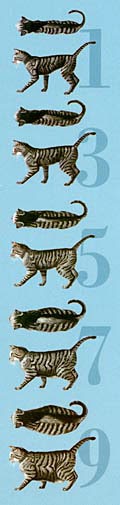
Keeping fat to a minimum is crucial to expanding your cat's life span, so it is important to visually and physically examine your cat. A cat's normal, healthy weight will vary depending on the breed, gender, and spay or neuter status. So here are some guidelines to determine if your cat's weight is normal.
  • Feel the cat's ribs. Ideally, there should be easily felt but not visibly sticking out. The ribs should be covered with a layer of fat, but not to an extent that would make it difficult to feel them. If you can see the ribs, the cat is too thin. If you can not feel them at all, the cat is very overweight.
  • Feel other bony prominences on the pet's body such as the the base of the tail, spine, shoulders, and hips. Anything more than light fleshiness indicates that your pet is above normal weight.
  • Look at the cat from above. The shoulders should be more broad and noticeable than the waist. The hindquarters should be broader than the waist. If the waist is significantly larger or very well rounded in comparison with the shoulders and hindquarters, the cat is overweight.
  • Look at the cat from the side. If the belly of a cat protrudes, the cat may be overweight. The area behind the ribs should be smaller in diameter than the chest.
Fat cat

Cats ... in figures

Some interesting facts and figures about cats!
  • A cat's heart beats twice as fast as a human heart, at 110 to 140 beats per minute.
  • An average cat has 1-8 kittens per litter, and 2-3 litters per year.
  • During her productive life, one female cat could have more than 100 kittens.
  • A single pair of cats and their kittens can produce as many as 420,000 kittens in just 7 years.
  • Cats have 290 bones in their bodies, and 517 muscles.
  • The average age for an indoor cat is 15 years, while the average age for an outdoor cat is only 3 to 5 years.
  • A cat's normal body temperature is 101.5 degrees.
  • A cat's ear pivots 180 degrees. They have 30 muscles in each ear, and use twelve or more muscles to control their ear movement.
  • Cats are the sleepiest of all mammals. They spend 16 hours of each day sleeping. With that in mind, a seven year old cat has only been awake for two years of its life!
  • Cats spend 30% of their waking hours grooming themselves.
  • An adult cat has 32 teeth.


    Do cats always land on their feet?

    Whether or not a cat lands on her feet depends on several factors, including the distance she falls and the surface on which she falls.
    Cats have exceptional coordination and balance and a flexible musculoskeletal system. A falling cat will instinctively try to right herself from head to tail, first rotating the head into the proper position, and then sequentially spiraling the rest of the body so all the feet are oriented to the ground. As the body gains the right position, the cat will spread her legs and relax her muscles in anticipation of landing. Their feet and legs can cushion the impact.
    Cats have the tendency of being better able to survive falls from greater heights than lower ones. The most dangerous falls are from between two and six stories. Even though they can right themselves, their legs and feet can no longer absorb all of the shock. Above this height, there is a theory that the number of injuries decline, because cats reached a terminal velocity, they relax and spread themselves out like flying squirrels, minimizing injuries.
    So, your cat may be able to survive a fall – but, then again, she might not. You never know ... and prevention is always better than a visit to the vet's.


    Landing cat

    The cat eye, facts about cat vision

    • A cat's vision is superior at night in comparison to humans, and inferior in daylight.
    • Cats have a third eyelid, the nictitating membrane, which is a thin cover that closes from the side and appears when the cat's eyelid opens.
    • Unlike humans, cats do not need to blink their eyes on a regular basis to keep their eyes lubricated. Cats will, however, "squint" their eyes, usually as a form of communication.
    • Cats have an elliptical pupil, which opens & closes much faster than round types as in humans.
    • Cats can see in color, but are partially color blind. They have the equivalency of human red/green color blindness. (Reds appear green and greens appear red; or shades thereof.)
    • Cats don't see "detail" very well. To them, their person may appear hazy when standing in front of them.
    • Cats need 1/6th the amount of light that humans do to see. Their night vision is amazing!
    • Cats can see up to 120 feet away. Their peripheral vision is about 285 degrees.
    • Cats eyes come in three shapes: round, slanted and almond.
    • The color of a kitten's eyes will change as it grows older.
    • At birth, kittens can't see or hear. Cats open their eyes after five days and begin to develop their eyesight and hearing at approximately 2 weeks. They begin to walk at 20 days.
    • Kittens begin dreaming at just over one week old.

    Cat eyes